Last year, we bought an apartment, and one of my dreams was to turn the living room into a home cinema. Being a huge movie geek, I naturally got to that quite early after we moved in. Building it and hearing it come together has been an amazing experience.
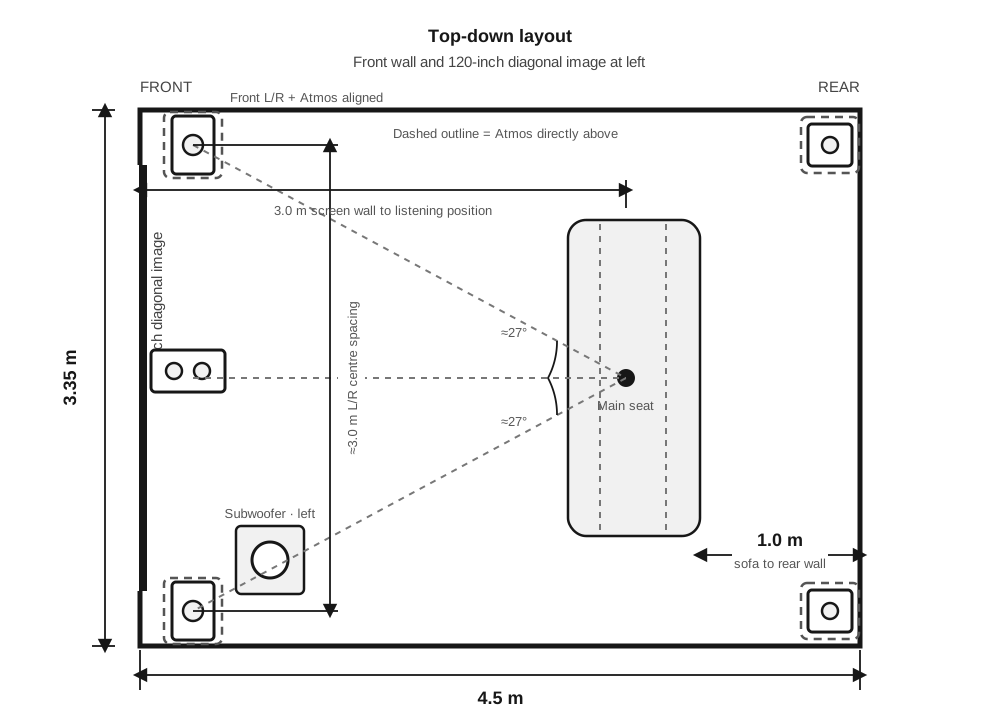
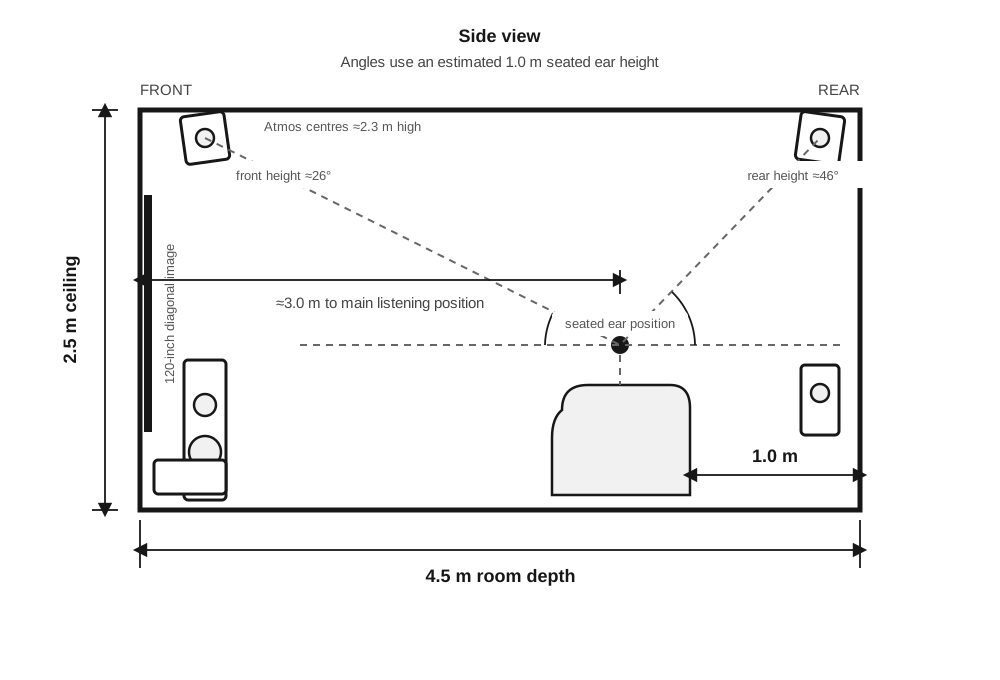
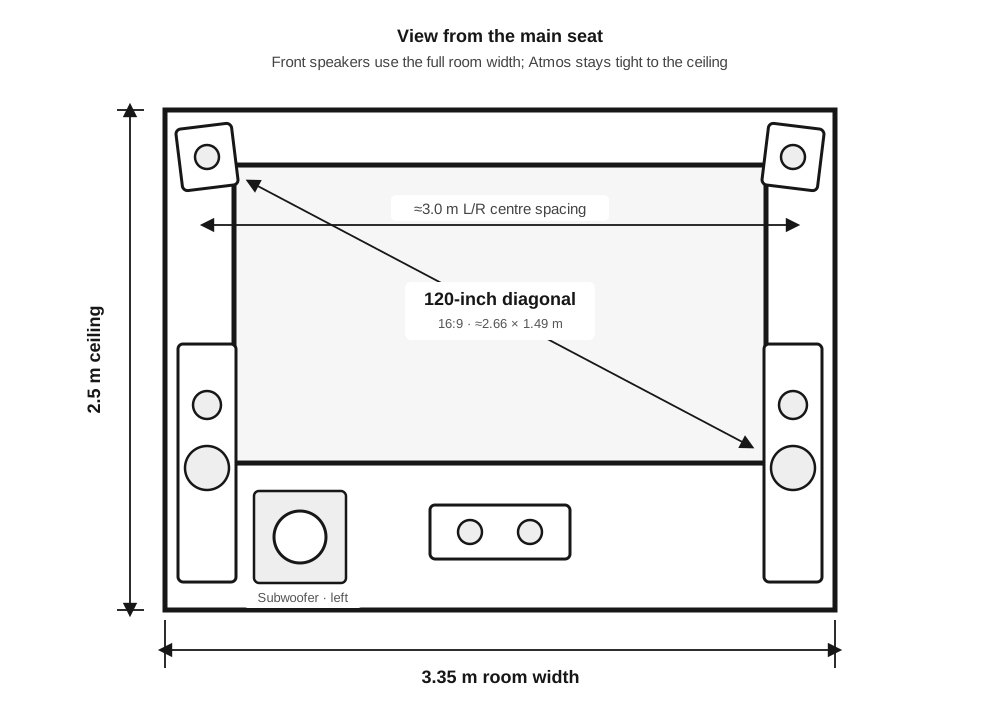
The room is about 4.5 × 3.35 × 2.5 metres, with a 120-inch projected image and the main seat roughly three metres away. It’s still our living room, so everything had to fit around the furniture, the ceiling and somewhere sensible to run the cables.
I ended up with a 5.1.4 Dolby Atmos system: five speakers around ear level, one subwoofer and four speakers for height effects. I love it. Films I know well keep surprising me with details I hadn’t noticed before.
What’s in the room
These are the components and the approximate prices I paid. The audio system came to around €2,300, with the Nvidia Shield and projector on top.
| Role | Component | Approx. price |
|---|---|---|
| Front left/right | ELAC Debut Reference DBR62 | €400 |
| Center | ELAC Uni-Fi 2.0 UC52 | €250 |
| Surrounds | 2× Polk Signature Elite ES10 | included below |
| Front heights | 2× Polk Signature Elite ES10 | included below |
| Rear heights | 2× Polk Signature Elite ES10 | ~€500 for all six Polk speakers |
| AV receiver | Onkyo TX-NR7100 with Dirac Live | €900 |
| Subwoofer | Mivoc Hype 10 G2 | €200 |
| Streaming | Nvidia Shield | €220 |
The centre speaker got more of my attention than I expected. It carries so much of the dialogue that I wanted to get it right. I chose the ELAC UC52 after reading Erin’s review and measurements. The DBR62 measurements at Audio Science Review helped with the front left and right. With a subwoofer in a room this size, I didn’t see much reason to buy towers.
The six little Polk ES10s were practical: small enough to fit, with mounting options that let me put them where I needed them. Two are surrounds and four sit just below the ceiling. The receiver supports nine amplified channels, so I chose four heights over two extra rear surrounds. I wanted to hear things move over the sofa from front to back.
Fitting it all in
The sofa is about a metre from the rear wall. The front height speakers sit above the left and right speakers, while the rear heights are behind the listening position. The front pair is on the wall, which is a compromise compared with putting them in the ceiling.
It works well in this room. The front heights extend the sound above the screen, and the rear pair makes overhead movement convincing. I used Dolby’s placement guide and the Onkyo layout options as references, then worked around what I could actually install.
The drawings below show the layout. Room dimensions and listening distance are measured; the seated ear height and height-speaker centres are estimates, so the angles are approximate.
Room plans and speaker positions
Getting the speakers to work together
Dirac Live was one of the reasons I bought the Onkyo. After calibration, dialogue felt more focused, the bass fitted better with the other speakers and sounds moved around the room more smoothly.
I took the first microphone measurement at ear height in the main seat, then kept the other positions around the sofa. The room had to be quiet and the microphone still. I preferred a target curve with a little extra bass to a completely flat one.
I moved and aimed the speakers before measuring. Calibration helped a lot, but I couldn’t expect it to undo an awkward speaker position.
The projector is a ViewSonic PX701HD. It gives me a bright 120-inch Full HD image and has been dependable, although by the time I wrote this it had used about 70% of its bulb life. A laser projector is on the wish list, along with a suspended ceiling for built-in height speakers. Neither feels urgent when I’m actually watching a film.
What I watch and listen to
For favourite films and testing, I prefer Blu-ray or UHD Blu-ray with a lossless soundtrack. I stream plenty too. The Atmos badge alone doesn’t tell you whether the audio is lossless, and two releases of a film can have different mixes or volume levels. I try to match the volume when comparing them rather than immediately crediting the format.
Some differences are subtle in dialogue and much easier to hear once the music, effects and bass build up. A good mix matters enormously. I keep coming back to Blade Runner 2049, Interstellar and Mad Max: Fury Road, partly for the sound and partly because I’m always happy to watch them again.
Over a year of skipping through films, I collected the scene list below. Times are in hours and minutes and can shift between cuts and releases. These are listening references, not a promise that every title has an Atmos mix.
My film scenes and timestamps
| Movie | Timestamp(s) | What I listen for |
|---|---|---|
| Ready Player One | 0:20, 1:36 | Racing and battle sequences with strong 360-degree movement |
| War of the Worlds | 0:20, 1:05 | Extreme low end, environmental destruction, and scale |
| Mad Max: Fury Road | Intro, 0:16, 0:20, 0:27 | Engines, vehicles, impacts, and constant directional motion |
| Interstellar | 1:00, 2:10, 2:17 | Organ, dynamics, spacecraft, bass, and an enormous soundstage |
| 1917 | 0:27, 1:07 | Environmental ambience, transitions, and explosive dynamics |
| Top Gun: Maverick | 1:35 | Jets, engine weight, aggressive panning, and height information |
| Blade Runner 2049 | 0:13, 0:20, 0:43, 0:58, 2:18 | Huge low end, electronic score, ambience, and room scale |
| Dunkirk | 0:06, 0:15, 0:35, 0:38, 1:12, 1:18, 1:23 | Aircraft, gunfire, tension, dynamics, and directionality |
| The Matrix | 1:45, 1:54 | Gunfire, bullet movement, impacts, and surround panning |
| Dune | 1:05 | Massive bass, scale, machinery, and score |
| Dune: Part Two | 0:54, 2:00, 2:13 | Sand, war, huge dynamics, and low-frequency energy |
| The Lost World: Jurassic Park | 1:05, 1:20, 1:50 | Dinosaurs, jungle atmosphere, impact, and low-frequency effects |
| Saving Private Ryan | 0:07 | Chaotic surround placement during the Omaha Beach sequence |
| Tenet | 0:40, 1:15, 1:30 | Bass, score, movement, and deliberately overwhelming dynamics |
| The Lord of the Rings: The Two Towers | 2:48 | Battle scale, crowds, score, and the surround field |
| The Matrix Reloaded | 1:30 | Freeway action, vehicle movement, and aggressive panning |
| Edge of Tomorrow | 0:17, 1:08 | Battlefield chaos, machinery, and explosions |
| The Lord of the Rings: The Return of the King | 1:56, 2:04, 2:20, 2:31, 2:40 | Battles, cavalry, creatures, score, and scale |
| Sinners | 0:55, 1:16, 1:35, 1:47 | Music, dynamics, atmosphere, and spatial detail |
| Tron: Ares | 0:03, 0:36, 0:58 | Electronic score, bass, and a wide synthetic soundstage |
| Inception | 0:09, 0:27, 1:05 | Bass hits, environmental destruction, and score |
| The Dark Knight | 1:15 | Dynamics, vehicles, impacts, and score |
| Superman | 0:30, 1:05 | Flight, action, score, and height effects |
| Harry Potter and the Goblet of Fire | 0:58, 1:12, 1:30 | Magical effects, creatures, ambience, and score |
| Alita: Battle Angel | 1:00 | Fast action, metallic effects, and bass |
| Alien: Romulus | 1:28 | Spacecraft ambience, machinery, and positional effects |
| Gravity | 0:45, 1:09 | Three-dimensional positioning and movement |
| Indiana Jones and the Temple of Doom | 1:35 | Action, movement, and classic adventure mixing |
| Transformers: The Last Knight | 0:53, 2:04 | Mechanical detail, huge impacts, and bass |
| Twisters | 1:00, 1:45 | Wind, debris, overhead movement, and bass |
| Furiosa: A Mad Max Saga | 1:05 | Engines, chase dynamics, and physical low end |
| Transformers: Age of Extinction | 1:18, 2:15 | Metallic impacts, explosions, and enormous scale |
| Avengers: Endgame | 2:18 | Final-battle scale, music, surrounds, and bass |
| Mission: Impossible | 0:27, 1:35 | Action, movement, and dynamics |
| A Quiet Place | 0:55 | Micro-detail, silence, and spatial positioning |
| Godzilla Minus One | 0:55 | Monster scale, impact, destruction, and low-frequency effects |
| Pacific Rim | 1:18 | Giant machines, giant monsters, impact, and scale |
| Spider-Man: Into the Spider-Verse | 1:04, 1:40 | Music, effects, width, and fast transitions |
| 300 | 0:45 | Stylized battle effects, impacts, and dynamics |
| Oppenheimer | 0:08 | Dynamic contrast, score, and low-frequency energy |
| Rogue One | 0:47, 1:38 | Spacecraft, lasers, battle movement, and score |
| Nope | 1:20 | Wide environmental sound and movement through the room |
| Hacksaw Ridge | 1:32 | Battlefield chaos, gunfire, explosions, and surrounds |
For music, I use this Speaker Test playlist. “Bubbles” by Yosi Horikawa is great for hearing where sounds sit, “Chocolate Chip Trip” by Tool for drums and dynamics, and “Keith Don’t Go” by Nils Lofgren for guitar detail and the space around it. They’re also good reasons to leave the measurements alone for a while and listen.
The longer selection below keeps the original 48 tracks, with their positions in the full playlist and what I listen for in each one.
48 tracks for testing speakers
| # | Track | Artist | What I listen for |
|---|---|---|---|
| 45 | Bubbles | Yosi Horikawa | Precise object placement, depth, height cues, and transient realism |
| 112 | Chocolate Chip Trip | Tool | Drum-kit positioning, huge transient swings, low-end impact, and room scale |
| 25 | Keith Don’t Go | Nils Lofgren | Acoustic-guitar transients, speed, string detail, and crowd ambience |
| 1 | Roxane | Petra Magoni, Ferruccio Spinetti | Vocal presence, upright-bass texture, and the space of the live room |
| 2 | Sympathy for the Devil | The Rolling Stones | Percussion placement, the gradual build, and separation as the mix fills up |
| 3 | Get Lucky | Daft Punk, Pharrell Williams, Nile Rodgers | Kick definition, rhythm-guitar transients, groove, and polished top-end detail |
| 5 | Little Wing | Jimi Hendrix | Guitar texture, image placement, and whether the upper mids become aggressive |
| 6 | High by the Beach | Lana Del Rey | Deep synthesized bass beneath an airy, layered vocal |
| 7 | Keep the Streets Empty for Me | Fever Ray | Low-level ambience, vocal focus, and a dark soundstage that should stay open |
| 8 | My Home Is in the Delta | Muddy Waters | Natural voice and guitar tone, body, and the recorded room |
| 10 | Chan Chan | Buena Vista Social Club | Acoustic imaging, percussion layers, and convincing instrument scale |
| 11 | Long After You’re Gone | Chris Jones, Steve Baker | Male vocal weight, guitar resonance, and sharply placed harmonica |
| 12 | All Your Love (Turned to Passion) | Sara K. | Vocal intimacy, acoustic attack, and clean decay |
| 14 | Brothers in Arms | Club for Five | Five-part vocal separation, center stability, and bass-vocal extension |
| 15 | Beatles’ Medley | Tommy Emmanuel | Fingerstyle speed, string attack, dynamics, and live-room cues |
| 17 | Só Danço Samba | Stan Getz, João Gilberto, Antônio Carlos Jobim | Saxophone tone, stereo placement, breath, and gentle percussion |
| 19 | Kiss in Blue | Yello, Heidi Happy | Deep electronic bass, a centered vocal, and wide synthetic effects |
| 20 | Fading Sun | Terje Isungset, Lena Nymark | Fragile transients, unusual percussion, air, and long reverberation |
| 21 | Detach | Hans Zimmer | Organ weight, slow dynamic escalation, and large-scale low end |
| 22 | Little Wing | Stevie Ray Vaughan | Electric-guitar body, amplifier texture, and sustained dynamics |
| 23 | A Woman’s Worth (Live – Unplugged) | Alicia Keys | Vocal power, piano weight, audience ambience, and live-stage depth |
| 26 | Bass & Drum Intro – Live | Nils Lofgren | Bass articulation, kick impact, drum attack, and live dynamics |
| 27 | Take Me Into Your Skin | Trentemøller | Sub-bass control, electronic layers, and a soundstage that expands gradually |
| 32 | Janie Runaway | Steely Dan | Studio precision, horn separation, tonal balance, and small mix details |
| 37 | Tricycle | Flim & the BB’s | Fast percussion, bass stops and starts, dynamics, and stereo imaging |
| 40 | Little Sadie | Crooked Still | String texture, bow attack, vocal placement, and acoustic separation |
| 43 | Walk on the Wild Side | Lou Reed | The double bass line, centered vocal, backing-vocal spread, and saxophone tone |
| 44 | Three O’Clock Blues | Eric Clapton, B.B. King | Two guitars occupying distinct spaces, vocal tone, and restrained dynamics |
| 46 | Colibria | Nicola Cruz | Layered percussion, low-end rhythm, width, and front-to-back depth |
| 48 | The First Quarter | Vladislav Delay | Very low textures, patience in the noise floor, and bass control |
| 49 | Whispers, Pt. 1 | Culprate | Microdetail, dense layering, quick transients, and complex low end |
| 50 | Me and Your Mama | Childish Gambino | The quiet-to-loud jump, vocal intensity, distortion, and composure under pressure |
| 52 | Flight of the Cosmic Hippo | Béla Fleck and the Flecktones | Deep electric-bass notes, pitch definition, and acoustic contrast |
| 56 | Oxytocin | Billie Eilish | Subwoofer extension, tight electronic kick, and layered vocal effects |
| 65 | Looped | Kiasmos | Piano texture against electronic pulses, gradual build, and image depth |
| 67 | The National Anthem | Radiohead | Bass repetition, increasing horn density, and separation inside deliberate chaos |
| 69 | Invincible | Tool | Long-form dynamics, drum weight, guitar layering, and bass control at volume |
| 70 | Lonesome Lover | Max Roach | Cymbal texture, horn bite, rhythmic precision, and jazz ensemble scale |
| 71 | Rhapsody in Blue | Leonard Bernstein, Columbia Symphony Orchestra | Piano tone, orchestral width, large dynamic swings, and hall ambience |
| 72 | Uh Uh | Thundercat | Extremely fast bass articulation and whether individual notes remain readable |
| 73 | Montagues and Capulets (Live) | Riccardo Muti, Chicago Symphony Orchestra | Orchestral scale, brass weight, quiet detail, and live-hall depth |
| 74 | Birds | Dominique Fils-Aimé | Layered voices, breath, center imaging, and controlled low percussion |
| 75 | Hanuman | Rodrigo y Gabriela | Rapid acoustic transients, left/right interplay, and rhythmic drive |
| 76 | Fever | Ray Charles, Natalie Cole | Duet placement, vocal texture, piano body, and the space between performers |
| 79 | Moby Dick | Led Zeppelin | Drum impact, tom weight, room sound, and dynamic headroom |
| 86 | Angel | Massive Attack, Horace Andy | Sustained deep bass, mounting pressure, vocal stability, and system control |
| 98 | Don’t Know Why | Norah Jones | Vocal naturalness, piano tone, brush detail, and a locked center image |
| 100 | Emerald Rush | Jon Hopkins | Layered electronic motion, bass precision, dynamic build, and clean treble |
I’m very happy with how the system turned out. On a good soundtrack, the room feels much bigger than it is, and the sound matches the scale of the picture. That makes the research, drilling and cables feel worth it.
I still find myself looking at better subwoofers, of course.